As it happens on Sunday afternoons, I am lazy and drowsy. But, well, I have a deadline and I have to finish something; so I try to keep myself awake and work. The going gets difficult at times though, and I have to take short breaks once in a while to get my concentration back. A little pacing inside the room, a little absent-minded gaze on the walls, a cursory look at the pile of books by my side, a quick snacking of fruits (oranges today) – one of these methods eventually gets me rejuvenated and I get back to my work. The concentration, on an average, stays between half an hour and one hour. After that, of course, it’s time for the next break. Indeed, how much lazier can one get!
So, I was practicing the absent-minded-gaze this afternoon, when my eyes fell on the multiple unread books lying in small heaps all around. I should mention here that I have a habit of tossing up books all around the room and it takes about a week to turn neatly stacked books into a mess that I lovingly create. It’s not easy to understand why I do it, but I would love to call it ‘carefully careless reading’ if that can help me do away with being messy.
Well, for those who’ve known me, nothing new in all these, of course. What is new about today, however, is that I happened to be quite amused this afternoon by looking at the way these piles of books were lying. So, on one side of my pillow lay books of Murakami’s short stories with Nalini Jonses’, both half read, with pages open, spine up, flat upon their bellies. On the other side lay unread books by three writers, as disparate as they can be – Alice Munro’s short stories and Thomas Mann’s grave-looking novel sandwiching the newbie writer Siddhartha Deb (poor Deb, who knew he would ever come between such heavyweights). The other bed on which I sit and work, I find that the scene is a little more crowded. Here, Vikram Seth’s slim travelogue is sitting atop Marquez, Guenter Grass, and Vikram Chandra (which, incidentally, is a giant book, enough to serve as a mini pillow). Beside this stack is another one where Kamila Shamsie’s feisty (bright and colorful cover) novel is jostling for space with Dario Fo’s memoir, Rana Dasgupta’s modern-day fables of stranded passengers on their way to Tokyo, and some other authors who I’m suddenly too lazy to write down now. But, of course, I cannot get away without mentioning the Qurratulain Haider’s novel, which sits alone, a little farther from the hustle and bustle, as if it decided to do so on its own will. Probably, some books do have their own personality, after all.
Hmm, enough of running wild, I guess. The work beckons me again.
PS: Barring a couple of them, all these books are waiting to be picked up some day. Sigh!
Sunday, February 08, 2009


Sunday, February 01, 2009
Strange worlds
I’ve earlier mentioned about my liking for fiction. But, in fiction too, I have a particular liking for short stories, which I probably haven’t mentioned earlier. Anyway, what I’m getting at is: these days my readings are usually so novel-centric that short stories do not get as much attention, although it was short stories that attracted me to books in the first place. In fact, not just stories in books, I also grew up listening to stories narrated by my grandmother. So, the taste of stories actually built up even before I picked up a book.
My earlier reading of short stories revolved around simple narratives, where something always happened, someone died or lived happily ever after, someone got punished or rewarded. They were linear, straightforward, and easy to read. I devoured them. Those were days of simple unbridled joys.
Then came the discoveries of other short stories – more experimental – not necessarily concerned with time span, more with the inner workings of the characters. And sometimes, the characters behaved in a manner so uncouth and unbecoming (so I thought back then) that I was startled to no end. In these stories, people behaved in manners not deemed proper, there were no happy endings; well, sometimes no endings at all. And not to mention, sometimes, the stories touched on themes that were probably not meant for young readers like me. But, I read them anyway, with palpitating heart and a strange awakening of something inside that was all hazy yet attractive. I was lucky in a way that nobody monitored what I read. Those were the days of strange discoveries, unknown fears and joys. And, probably, those days are still not over, never will. I'm still discovering stranger worlds.
Anyway, the reason I blabbered all these is because I had been reading Haruki Murakami’s excellent collection of short stories Blind Willow, Sleeping Woman (link to a review of the book), which is full of strange, elliptical, and yet delightful stories. Many a times, after reading a story from the book, I throw the book aside, come out to the balcony, stare outside and wonder who these people in the stories may be.
Well, I guess I shouldn't wonder. I would probably appear as strange if someone writes a story about me. Or, about anyone else for that matter.
My earlier reading of short stories revolved around simple narratives, where something always happened, someone died or lived happily ever after, someone got punished or rewarded. They were linear, straightforward, and easy to read. I devoured them. Those were days of simple unbridled joys.
Then came the discoveries of other short stories – more experimental – not necessarily concerned with time span, more with the inner workings of the characters. And sometimes, the characters behaved in a manner so uncouth and unbecoming (so I thought back then) that I was startled to no end. In these stories, people behaved in manners not deemed proper, there were no happy endings; well, sometimes no endings at all. And not to mention, sometimes, the stories touched on themes that were probably not meant for young readers like me. But, I read them anyway, with palpitating heart and a strange awakening of something inside that was all hazy yet attractive. I was lucky in a way that nobody monitored what I read. Those were the days of strange discoveries, unknown fears and joys. And, probably, those days are still not over, never will. I'm still discovering stranger worlds.
Anyway, the reason I blabbered all these is because I had been reading Haruki Murakami’s excellent collection of short stories Blind Willow, Sleeping Woman (link to a review of the book), which is full of strange, elliptical, and yet delightful stories. Many a times, after reading a story from the book, I throw the book aside, come out to the balcony, stare outside and wonder who these people in the stories may be.
Well, I guess I shouldn't wonder. I would probably appear as strange if someone writes a story about me. Or, about anyone else for that matter.
Thursday, January 29, 2009
Almost
I don’t know if you may have noticed earlier, but there were many times when I came very close to give up writing this blog for various reasons – caught up with work, nothing to write about, worried about money and career, depressed with life, unhappy with the shoddy attempts at writing, etc. But so far, somehow, I have remained unsuccessful to bring it to a complete end. I invariably came back every time after a brief hiatus.
I was going through one such phase again. And, well, this time it came pretty close to an end. Or, so I thought. I was almost convinced that this blog was going nowhere – it can just as well be done away with and left alone to die a quiet death.
The last few days, I must admit, I swung like a pendulum, thinking over it. I had no obvious answers either way. And I almost lost my sleep trying to decide. However, I later realized, from the little I know about the workings of my mind, that given a lifetime, I would still be indecisive about it.
I know it seems funny that I could have been agitated over such a petty thing. After all, why could it even matter in any real sense? Seriously, I still cannot understand why I should’ve lost my sleep for something like this. But, well, I guess I don’t understand many things about me anyway.
Okay, so if you are reading this, you can see that I did finally make the decision. But, it was an impulsive decision, like always, and I can’t say what good will come out of it. Moreover, it really could have gone either way, just like the toss of a coin. The reason that it didn’t go the other way, is purely accidental, and therefore beyond any explanation.
I can see that this has turned out to be a strange post, very unusual for a first post of the new year. Don’t know what this portends.
Anyway, for now, I am back.
I was going through one such phase again. And, well, this time it came pretty close to an end. Or, so I thought. I was almost convinced that this blog was going nowhere – it can just as well be done away with and left alone to die a quiet death.
The last few days, I must admit, I swung like a pendulum, thinking over it. I had no obvious answers either way. And I almost lost my sleep trying to decide. However, I later realized, from the little I know about the workings of my mind, that given a lifetime, I would still be indecisive about it.
I know it seems funny that I could have been agitated over such a petty thing. After all, why could it even matter in any real sense? Seriously, I still cannot understand why I should’ve lost my sleep for something like this. But, well, I guess I don’t understand many things about me anyway.
Okay, so if you are reading this, you can see that I did finally make the decision. But, it was an impulsive decision, like always, and I can’t say what good will come out of it. Moreover, it really could have gone either way, just like the toss of a coin. The reason that it didn’t go the other way, is purely accidental, and therefore beyond any explanation.
I can see that this has turned out to be a strange post, very unusual for a first post of the new year. Don’t know what this portends.
Anyway, for now, I am back.
Friday, December 19, 2008
Snippets
- We go eating sizzlers. At a bustling place, with old friends from college days. As it happens on such occasions, we talk about halcyon days of past and stir up memories of people we knew. We talk incessantly, behave noisily, eat clumsily, and laugh out loudly at the tiniest of anecdotes we share. After so many years, even the painful memories now seem laughable.
- I’m packing my bags for year-end holidays. I am going away for few days and there’s not much to pack anyway, I think. But this morning, I run around and pile up things that I need to carry – clothes, tickets, slippers, books. Oh, books! I take maximum time to decide which books to carry with me for holiday read. I know, I won’t probably read much, but then I am bugged by the thought, “What if I feel like picking up a book? What if I feel like picking up this particular book?”
- So, another year went by. And minor ups and downs apart, I think it went quite well with me. I don’t really like to do year-end assessments, nor new-year resolutions. Therefore, instead, I’m going on hibernation for the next two weeks.
Happy 2009!
Friday, December 12, 2008
Am still here
I feel flattered that some people are taking out time from their busy schedules and wondering about why I haven’t posted on the blog for so long. It is even more surprising (pleasantly, of course) to find that these people are coming in regularly to check whether something new has been written on the blog. Neither my stony silence nor the repeated disappointments could deter them from visiting.
And I must say I am mighty impressed by their remarkable persistence. And I thought that I owed one post for them, even if it is just to signal that I’m not dead yet.
So what kept me away from writing? Well, it was work mostly, but I also somehow didn’t feel the desire to say anything. It is, as if, I have run out of things to say, and whatever I want to say seems totally dispensable. This feeling has somehow made into my mind and I don't see any changes to it happening in the coming days.
Cannot say when I shall be back again, but don't worry because I am alive and kicking.
By the way, before I leave, here are three photos from a recent trip. Posting photos, as you know, is a sign that I have run out of things to write about. Hope I get over this phase soon.
 dragonflies flitting about at vijaydurg
 sunshine on water at sindhudurg
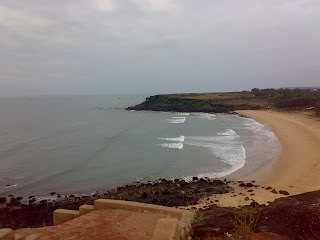 sunset at the quiet beach at devgad
And no, this post was not written with pen and paper. In fact, recently, I have started typing away even more furiously on the keyboard; haven't got much chance to write with the pen ever since.
And I must say I am mighty impressed by their remarkable persistence. And I thought that I owed one post for them, even if it is just to signal that I’m not dead yet.
So what kept me away from writing? Well, it was work mostly, but I also somehow didn’t feel the desire to say anything. It is, as if, I have run out of things to say, and whatever I want to say seems totally dispensable. This feeling has somehow made into my mind and I don't see any changes to it happening in the coming days.
Cannot say when I shall be back again, but don't worry because I am alive and kicking.
By the way, before I leave, here are three photos from a recent trip. Posting photos, as you know, is a sign that I have run out of things to write about. Hope I get over this phase soon.
 dragonflies flitting about at vijaydurg
 sunshine on water at sindhudurg
 sunset at the quiet beach at devgad
And no, this post was not written with pen and paper. In fact, recently, I have started typing away even more furiously on the keyboard; haven't got much chance to write with the pen ever since.
Thursday, November 13, 2008
Penmanship
The last few days I had been trying to write with a fountain pen. I got it as a gift this Diwali and had since been itching to write something with it. The gleaming pen itself looked very inviting – the nib glided effortlessly on paper, the ink flowed smoothly, and my own handwriting (dare I say) appeared likeable, if not exactly calligraphic.
Anyway, so, with pen in my hand I started scribbling everywhere – a signature here on the flyleaf of a book, a random line there between the newspaper columns, or even at the back of grocery bills. Well, basically, on anything that came close to the pen. Obviously, I was delighted with this new possession.
That was until I sat down to write something in a more disciplined way. Now I realized the trouble I had in my hand – I cannot do a Ctrl + z to undo what I just wrote, I have to strike out and leave an ugly mark; I cannot Ctrl + c and Ctrl + v a line, I have to write every single character; I cannot hyperlink, neither can I run a spellchecker. Probably, the only saving grace was that I was relieved from doing a Ctrl + s every time I wrote anything. But it was a small consolation. In the absence of an undo option, the page I was writing on resembled more like a cryptic puzzle with misbehaved words running randomly between the lines and making a complete mess.
Much though I tried writing with the pen, it was apparent how much I relied upon Microsoft Word. Usually, I am not the one who always laments giving up all old ways of doing things, but it was a bit unsettling to find that I could feel so uneasy when writing with a pen, which I once enjoyed much.
However, I am not giving up on writing with the pen yet. I still playfully scribble with it everywhere. And hopefully, one of these days, I shall write a blog post with the pen. Or, a letter maybe. Well, anything, as long as it gets written.
PS: One thing makes me wonder. Now that there are technologies assisting us to write and format better, it's odd that I find increasing instances of shoddy writing. And I don’t just mean the ubiquitous misspelled hoardings and signboards. I mean the emails, the SMSes, the chat messages, the documents you come across at workplaces. Everywhere.
Anyway, so, with pen in my hand I started scribbling everywhere – a signature here on the flyleaf of a book, a random line there between the newspaper columns, or even at the back of grocery bills. Well, basically, on anything that came close to the pen. Obviously, I was delighted with this new possession.
That was until I sat down to write something in a more disciplined way. Now I realized the trouble I had in my hand – I cannot do a Ctrl + z to undo what I just wrote, I have to strike out and leave an ugly mark; I cannot Ctrl + c and Ctrl + v a line, I have to write every single character; I cannot hyperlink, neither can I run a spellchecker. Probably, the only saving grace was that I was relieved from doing a Ctrl + s every time I wrote anything. But it was a small consolation. In the absence of an undo option, the page I was writing on resembled more like a cryptic puzzle with misbehaved words running randomly between the lines and making a complete mess.
Much though I tried writing with the pen, it was apparent how much I relied upon Microsoft Word. Usually, I am not the one who always laments giving up all old ways of doing things, but it was a bit unsettling to find that I could feel so uneasy when writing with a pen, which I once enjoyed much.
However, I am not giving up on writing with the pen yet. I still playfully scribble with it everywhere. And hopefully, one of these days, I shall write a blog post with the pen. Or, a letter maybe. Well, anything, as long as it gets written.
PS: One thing makes me wonder. Now that there are technologies assisting us to write and format better, it's odd that I find increasing instances of shoddy writing. And I don’t just mean the ubiquitous misspelled hoardings and signboards. I mean the emails, the SMSes, the chat messages, the documents you come across at workplaces. Everywhere.
Monday, November 03, 2008
Hunger
This novel cannot even claim to have a redeeming social value. Although Hunger puts us in the jaws of misery, it offers no analysis of that misery, contains no call for political action. Hamsun, who turned a fascist in his old age during the Second World War, never concerned himself with the problems of class injustice, and his narrator – hero, like Dostoevsky's Raskolnikov, is not so much of an underdog as a monster of intellectual arrogance. Pity plays no part in Hunger. The hero suffers, but only because he has chosen to suffer. Hamsun's art is such that he rigorously prevents us from feeling any compassion for his character. From the very beginning, it is made clear that the hero need not starve. Solutions exist, if not in the city, then at least in departure. But buoyed by an obsessive, suicidal pride, the young man's action continually betray a scorn for his own best interests.
– Paul Auster, in an Introduction to Knut Hamsun's Hunger
Thursday, October 23, 2008
If it's not for you, it's not for you
The first time I saw this one, I just felt it was way too intelligent. The second time I saw it, I thought the tag line sounded almost prophetic. The third time I saw it, I chose to forget my earlier promise (of not linking to YouTube videos) and decided to put it up on the blog, anyway.
On dull evenings
For the last few days, I was a little annoyed with the fact that my reading had taken a back seat. Each evening after coming home I would be overcome with a strange sense of futility for all things I do, reading included. And all I really wanted on these evenings was to blot out my thoughts altogether, if at all that was possible. I was reading less not because I had been busy doing other things, but because I was overcome with a strange sense of – what can I call it – ennui, maybe. Each day, I watched at the pile of books lying unread, and I got more annoyed with myself. And the more I thought about them, the more I became aware of the time passing me by, most of which, I am afraid, rather gone as a waste.
Still, the little I read recently, I read mostly by jumping from one book to another. As a result, I have a series of unfinished books, strewn all over the place.
I don’t know when I am going to catch up with my reading. But, in the meantime, I am busy with something else – watching Kieslowski’s Dekalog (or, The Decalogue), one part each evening. I watched the first two parts of this Kieslowski masterpiece two years back at Pune International Film Festival, and was completely bowled over by what I saw. And, it’s been a wish since then to catch all the ten films of Dekalog someday. As it happens, I have recently come across the complete Dekalog. And thus, at least for 10 days, I have my evenings occupied.
I have read/heard so many different accounts from people declaring how Dekalog has changed their attitude and perspective to films that I am mildly excited to find out how my own experience will be. Of course, the first two parts were influential enough, but I wanted to see the whole thing and then decide for myself.
So, for now I'll be just watching a part each evening and hopefully, I’ll try to write about my experience when I am done watching the complete Dekalog.
Still, the little I read recently, I read mostly by jumping from one book to another. As a result, I have a series of unfinished books, strewn all over the place.
I don’t know when I am going to catch up with my reading. But, in the meantime, I am busy with something else – watching Kieslowski’s Dekalog (or, The Decalogue), one part each evening. I watched the first two parts of this Kieslowski masterpiece two years back at Pune International Film Festival, and was completely bowled over by what I saw. And, it’s been a wish since then to catch all the ten films of Dekalog someday. As it happens, I have recently come across the complete Dekalog. And thus, at least for 10 days, I have my evenings occupied.
I have read/heard so many different accounts from people declaring how Dekalog has changed their attitude and perspective to films that I am mildly excited to find out how my own experience will be. Of course, the first two parts were influential enough, but I wanted to see the whole thing and then decide for myself.
So, for now I'll be just watching a part each evening and hopefully, I’ll try to write about my experience when I am done watching the complete Dekalog.
Monday, October 20, 2008
Disparate
- A few days back, coming home late one night, I felt a mild chill in the air. It’s mid-October, and winter is slowly making its way, I realized. Of course, the days are still warm, sometimes even hot, but the evenings have started to show distinct signs of the changing season. However, unlike the other places I have lived, winter here is mild and short-lived – none of those thick shroud of fog or biting cold days are seen here – but it’s pleasant and enjoyable nevertheless. As I was riding back home that evening, my mind flew back to many winter days and nights from yesteryears – the sound of dewdrops dripping from the mango tree near the window at night, back at my home; the fogs floating over the surface of the lakes in my college campus, adding bits of mystery to the drab winter mornings, when I walked to class; the bonfires I saw at the grandparents village, which besides giving warmth on winter evenings, were also a huge attraction in my childhood, often the smell of smoke clinging to the clothes as I fell into a cozy sleep; the grey winter mornings of Delhi, which seemed extremely dry, cold, and cruel. Also, not to forget, the heavenly delight of eating oranges sitting in the mild winter afternoon sun, especially after a siesta. Ah, I never realized I had been through so many winters already!
- In my building, just near the place where I park my bike, there is a pair of trees with tiny fragrant flowers; the air around them gets heavy and fragrant in the evenings when they bloom, and in the mornings they fall off and the ground becomes almost a white carpet of flowers. I know the name of the flower – shewali it is called in my tongue, but I think it’s known as prajakta here, also harshingar in some other parts – it generally starts flowering early October in eastern India and signals the arrival of Durga Puja. Though it’s associated with a happy festival, for some unknown reason it is known as a ‘flower of sorrow.’ Maybe, it’s because of its haunting fragrance, or maybe because the poor flower cannot withstand the harsh light of day. I don’t know, really.
- The other day, when I was in one of the training sessions, the talk veered to the concept of trust. The presenter said, “Trust is something like a tree – a long time is needed to make it grow, but it can be sawed down in minutes.” For some reason, I liked this definition, and it got into my head.
- Deepavali (or Diwali), the Indian festival of lights, is just a few days away. In many ways it’s a beautiful festival, especially with the rows of lights lit up at each household. The last few Deepavalis, I have mostly spent alone, watching the flickering earthen diyas, and it made me be at peace, despite the shattering noise of crackers in the neighborhood. These days, I realize, Deepavali doesn’t make me very cheerful or upbeat like yesteryears, but neither does it make me outright gloomy; only a feeling quiet well-being and contentment surrounds me on the festive evening, just like the soothing light of the diyas – it keeps the darkness away, but it's not so bright that it can dazzle the eye. Well, this is strange analogy, maybe. Growing age really does strange things to you!
Friday, October 10, 2008
Atlas found
The long hours I spend on the internet – in pursuit of knowledge of wisdom, of course – I discover many things. The one I found today is Our Dumb World: The Onion's Atlas Of The Planet Earth – which provides us with nuggets of knowledge about nearly all the countries in the world. Well, the website just gives us a sneak peek; the full book in print needs to be bought to be savoured.
Anyway, couldn’t resist giving you some of the country profiles I enjoyed reading (in total random order):
Anyway, couldn’t resist giving you some of the country profiles I enjoyed reading (in total random order):
AustraliaGo find out more from the website, if you, like me, are in endless pursuit of knowledge, often from nooks and corners of the vast world of internet. I, for one, after going through Onion's atlas, figured out where exactly Estonia is on the map.
Once home to some of the most diverse and undisturbed wildlife in the world, the nation of Australia has fallen prey to a deadly scourge of nature shows, with dozens of endemic species being poked, prodded, and bothered to the brink of extinction.
Estonia
The merry nation of Estonia has been under foreign control for most of its history, due to the fact that its main form of defense is holding hands and singing.
France
Home to Earth’s entire population of 62.7 million people, every single one of the planet’s 427 cities, and all of its history, culture, and beauty, France is the only country in the world.
Belgium
While known worldwide for its delicious chocolates, mouth-watering waffles, and extraordinary desserts, there is a lot more to the nation of Belgium than first meets the eye. For instance, the country is also home to delectable pies, scrumptious pastries, custards, ice creams, and truffles.
India
Mired by rising poverty levels, polluted groundwater that threatens the lives of millions, and a rapidly crumbling infrastructure, the nation of India have every intention of addressing these problems just as soon as it finishes telling Midwesterners how to install Windows XP on their home computer.
China
With over 700 billion citizens manufactured since 1892, China is the world’s largest mass producer of Chinese.
United States
The United States was founded in 1776 on the principle of life, liberty, and the reckless pursuit of happiness at any cost – even life and liberty.
Wednesday, October 08, 2008
We make memories everyday
Ah, so I come back at last.
No, there’s no excuse for being quiet all these days. And neither is there any reason for suddenly coming alive today. It was simply purely whimsical of me. Or maybe, as they say, real life intruded; so, was probably busy dealing with real life.
Anyway, if you are wondering about the title of this post, I must admit I stole it from a random comment on ted.com, which I sometimes visit for the numerous wonderful, informative, and thought-provoking videos posted on the site. There was something I liked about that sentence, and I thought it should be the title of my next post (whenever it was going to be written).
As it turns out, something about today (I don’t know what) made me put up a post.
So, what was about that sentence I read that struck me, I asked myself later. After all, it’s just a plain statement, and it doesn’t even tell us anything that we don’t know already.
Well, maybe, it struck me because I somehow realized in a flash that all these routine, mundane, and uneventful days I am living are in fact quietly turning into a vast pool of memories. Everyday, unknown to me, I am building up memories – the people I meet, the things I do, or don’t do, the thoughts that cross my mind, the things I avoid, the hours I spend working on my desk, the smiles I share, the words I speak, the meals I eat, the books I read – all these end up knitting an intricate web of memories; how and when these memories will finally emerge I cannot tell. Which seemed mysterious because I don’t know how much of what will stay in memory and at what unexpected time I will remember them again.
I often tend to remember some utterly insignificant things when a much more important thing was happening to me. For example, every time I remember the meeting at the railway station when I was seeing someone off for the last time, I remember the red blinking lights of a weighing machine on the platform. Or, when I try and remember some particular conversation, I remember the cramped PCO booth with dangling wires from where I was making the call. Or, when I try to recall a very old incident from my childhood, more than anything else I remember a steel glass rolling on the floor, the spilt milk getting soaked into the sand.
Memories are indeed trickier than we can probably imagine. Who knows what I’ll remember of these days when I look back. What of these days will remain?
I guess I am just rambling. Better shut off now. Until later.
No, there’s no excuse for being quiet all these days. And neither is there any reason for suddenly coming alive today. It was simply purely whimsical of me. Or maybe, as they say, real life intruded; so, was probably busy dealing with real life.
Anyway, if you are wondering about the title of this post, I must admit I stole it from a random comment on ted.com, which I sometimes visit for the numerous wonderful, informative, and thought-provoking videos posted on the site. There was something I liked about that sentence, and I thought it should be the title of my next post (whenever it was going to be written).
As it turns out, something about today (I don’t know what) made me put up a post.
So, what was about that sentence I read that struck me, I asked myself later. After all, it’s just a plain statement, and it doesn’t even tell us anything that we don’t know already.
Well, maybe, it struck me because I somehow realized in a flash that all these routine, mundane, and uneventful days I am living are in fact quietly turning into a vast pool of memories. Everyday, unknown to me, I am building up memories – the people I meet, the things I do, or don’t do, the thoughts that cross my mind, the things I avoid, the hours I spend working on my desk, the smiles I share, the words I speak, the meals I eat, the books I read – all these end up knitting an intricate web of memories; how and when these memories will finally emerge I cannot tell. Which seemed mysterious because I don’t know how much of what will stay in memory and at what unexpected time I will remember them again.
I often tend to remember some utterly insignificant things when a much more important thing was happening to me. For example, every time I remember the meeting at the railway station when I was seeing someone off for the last time, I remember the red blinking lights of a weighing machine on the platform. Or, when I try and remember some particular conversation, I remember the cramped PCO booth with dangling wires from where I was making the call. Or, when I try to recall a very old incident from my childhood, more than anything else I remember a steel glass rolling on the floor, the spilt milk getting soaked into the sand.
Memories are indeed trickier than we can probably imagine. Who knows what I’ll remember of these days when I look back. What of these days will remain?
I guess I am just rambling. Better shut off now. Until later.
Wednesday, August 27, 2008
From halfway
I'm halfway into An Equal Music, and even when I picked up the book, I knew An Equal Music was different from A Suitable Boy or The Golden Gate, the two Vikram Seth books I've read earlier, and enjoyed – The Golden Gate for its yuppy quirkinesss and A Suitable Boy for the sweeping canvas. But, for me, An Equal Music is not proving to be an easy read. There may be few reasons: first, it's a book with western classical music as a theme and there're a lot of details I had difficulty following; second, the style of writing, at least to me, seemed so unlike the earlier Seth I've read, and much of the time I had to struggle, despite the book being divided into short readable chapters. Besides, even after reaching halfway, I'm still not getting a pulse of the characters, and I wonder if it is intentional on the part of the writer, or is there something lacking about the way it's written. I'm still reading it, however slowly, and I hope to complete the book in a few days. Vikram Seth is known for writing about immensely diverse themes and reading An Equal Music after A Suitable Boy I cannot agree more. And probably because A Suitable Boy remains so entrenched in my mind, An Equal Music is turning out to be a bit disappointing, after all.She frowns. "The thing about camellias, you know, is that when they're about to die, they won't tell you in time. If they lack water, they don't look unhappy for a while, and show you they're suffering; they just die."From An Equal Music, Vikram Seth
Thursday, August 21, 2008
At office
I generally keep office out of this blog, and it’s better that way, I guess. But, something happened at office today which I thought I needed to write, maybe just to get it out of my system and forget it. After all, I know people who does that – write to get things out of system. I thought I too should give it a try.
So, it happened that I had booked a conference room for a meeting today, but I didn’t really check out the time zone (being a global company, the web request system has too many time zones available, none of which I was aware of). Therefore, when we go to the conference room, and are in the middle of a call, someone dashes in and interrupts us. He comes in without even caring to knock. He has a frown on his face and almost makes us a gesture to get out. He has the air of someone who seems to be extremely busy, and therefore has no time to even have a decent talk to explain anything. “I have a booking for this room right now,” he says. I, being not very good at countering and always overvaluing politeness, try to mumble something like, “But I did make a reservation for this!” At this he frowns upon me and opens his laptop to show his reservation. I did realize, by then, that I might have made a mistake (which I absolutely did because my reservation was showing a different time zone) and so we abandon the call and move to the next conference room available. Luckily, the next room was unreserved and our call resumed smoothly and there was a not-too-bad ending to the whole thing, after all.
Now, what I want to convey here is that, is it wrong to expect politeness and decency from people around you, especially when you are working in an environment where everyone is (supposedly) highly educated? (The person who stormed into the conference room is a Principal Software Engineer, I later found out from the intranet, and probably is a heavyweight or something, but for me he is simply a man without manners.) I agree that people might be awfully busy and there might be lot many important things making them busy all the time, but is basic etiquette such a difficult thing to practice, after all? Or, is it a notion that politeness is synonymous with weakness? Is it that to move ahead you must get a permanent frown on your face, and intimidate others with your manners and words?
Well, I don’t want to appear to be shocked with this behavior – I have had my share of encounter with rudeness; in fact, plenty of them. But yes, it did manage to unsettle me for a moment because so far (and I’m indeed happy to say this) I didn’t really encounter too many nasty people at my workplace. Maybe, this was a precursor for things ahead!
Whatever, sorry to have disappointed you, if were expecting something different to read here. But, well, one needs to vent out occasionally, and what better place than a blog for doing that?
PS: While walking back home in the evening, I was thinking of this incident and it reminded me of an old essay I read in my schooldays – A.G. Gardiner's On Saying Please, which you can read here. A.G. Gardiner (1865–1946) wrote some delightful essays under the pen-name Alpha of the Plough and this essay is a good example of his excellent style and humour. It is sad that essays never enjoyed as much popularity as novels or short-stories. A collection of A.G. Gardiner's essays, namely Pebbles on the Shore, is available here.
So, it happened that I had booked a conference room for a meeting today, but I didn’t really check out the time zone (being a global company, the web request system has too many time zones available, none of which I was aware of). Therefore, when we go to the conference room, and are in the middle of a call, someone dashes in and interrupts us. He comes in without even caring to knock. He has a frown on his face and almost makes us a gesture to get out. He has the air of someone who seems to be extremely busy, and therefore has no time to even have a decent talk to explain anything. “I have a booking for this room right now,” he says. I, being not very good at countering and always overvaluing politeness, try to mumble something like, “But I did make a reservation for this!” At this he frowns upon me and opens his laptop to show his reservation. I did realize, by then, that I might have made a mistake (which I absolutely did because my reservation was showing a different time zone) and so we abandon the call and move to the next conference room available. Luckily, the next room was unreserved and our call resumed smoothly and there was a not-too-bad ending to the whole thing, after all.
Now, what I want to convey here is that, is it wrong to expect politeness and decency from people around you, especially when you are working in an environment where everyone is (supposedly) highly educated? (The person who stormed into the conference room is a Principal Software Engineer, I later found out from the intranet, and probably is a heavyweight or something, but for me he is simply a man without manners.) I agree that people might be awfully busy and there might be lot many important things making them busy all the time, but is basic etiquette such a difficult thing to practice, after all? Or, is it a notion that politeness is synonymous with weakness? Is it that to move ahead you must get a permanent frown on your face, and intimidate others with your manners and words?
Well, I don’t want to appear to be shocked with this behavior – I have had my share of encounter with rudeness; in fact, plenty of them. But yes, it did manage to unsettle me for a moment because so far (and I’m indeed happy to say this) I didn’t really encounter too many nasty people at my workplace. Maybe, this was a precursor for things ahead!
Whatever, sorry to have disappointed you, if were expecting something different to read here. But, well, one needs to vent out occasionally, and what better place than a blog for doing that?
PS: While walking back home in the evening, I was thinking of this incident and it reminded me of an old essay I read in my schooldays – A.G. Gardiner's On Saying Please, which you can read here. A.G. Gardiner (1865–1946) wrote some delightful essays under the pen-name Alpha of the Plough and this essay is a good example of his excellent style and humour. It is sad that essays never enjoyed as much popularity as novels or short-stories. A collection of A.G. Gardiner's essays, namely Pebbles on the Shore, is available here.
Friday, August 08, 2008
YouTubed
Just dropped in to link two YouTube short films (what else?)
Check out The Danish Poet and Harvie Krumpet, winners of Oscar for Best Animated Short Film for 2007 and 2004, respectively.
Last night, I was having a look at The YouTube Screening Room and found these two absolutely entertaining short films among others. Hope you enjoy them as much as I did.
By now it must be obvious that I’m wasting a lot of time watching YouTube videos, and it’s no wonder that some of them is spilling over here. But, well, no more YouTube videos in future, I promise.
Check out The Danish Poet and Harvie Krumpet, winners of Oscar for Best Animated Short Film for 2007 and 2004, respectively.
Last night, I was having a look at The YouTube Screening Room and found these two absolutely entertaining short films among others. Hope you enjoy them as much as I did.
By now it must be obvious that I’m wasting a lot of time watching YouTube videos, and it’s no wonder that some of them is spilling over here. But, well, no more YouTube videos in future, I promise.
Thursday, July 31, 2008
Aparajito
A few days back, when I was watching Aparajito – alone, late into the night – a strange sense of sadness came upon me. There was this particular scene where adolescent Apu, sitting by his somewhat dazed mother, is trying to explain a globe to her, and she looks at him with a look that is a mix of tenderness, awe, and happiness. Or the scene where the mother is packing Apu’s suitcase with much care, remembering to put all the things he might need for the journey ahead to Calcutta where he is going to study in a college – while Apu is eager and impatient to experience the new life of freedom and learning, his mother is concerned about the loneliness she feels to let him go away from her, which she comes to realize, is probably forever.
Aparajito, probably the least recognized of the Apu Trilogy, is an amazing film. It might not have the early lyrical appeal of Pather Panchali, or the later beauty and romance of Apur Sansar, but it’s a film of poignant realization – a film about growing up and growing apart, a subtle portrayal of increasing alienation from the one who loves you most.
Aparajito essentially is a story of mother-son relationship – a relationship that changes inevitably over time. It’s about a lonely mother who invests all her life to her son with the hope of a better future, only to realize that their futures can only grow apart, and about a son who is caught between the excitements of his dreams and his duty to remain close to his ageing mother. In fact, there’s nothing new to the theme, but the way Satyajit Ray crafts the film makes it an indelible experience to watch, almost emotionally draining.
It is a very difficult moment when you have to let go. It is specially so when you have to let go of something/someone you have nurtured all your life. You know it’s for better, but you can’t accept it either. Like Apu’s mother, who sees her son off with a vague smile, only to plunge into terrible loneliness the moment he is out of her sight.
Aparajito, probably the least recognized of the Apu Trilogy, is an amazing film. It might not have the early lyrical appeal of Pather Panchali, or the later beauty and romance of Apur Sansar, but it’s a film of poignant realization – a film about growing up and growing apart, a subtle portrayal of increasing alienation from the one who loves you most.
Aparajito essentially is a story of mother-son relationship – a relationship that changes inevitably over time. It’s about a lonely mother who invests all her life to her son with the hope of a better future, only to realize that their futures can only grow apart, and about a son who is caught between the excitements of his dreams and his duty to remain close to his ageing mother. In fact, there’s nothing new to the theme, but the way Satyajit Ray crafts the film makes it an indelible experience to watch, almost emotionally draining.
It is a very difficult moment when you have to let go. It is specially so when you have to let go of something/someone you have nurtured all your life. You know it’s for better, but you can’t accept it either. Like Apu’s mother, who sees her son off with a vague smile, only to plunge into terrible loneliness the moment he is out of her sight.
Friday, July 25, 2008
Slowness
"There is a secret bond between slowness and memory, between speed and forgetting. Consider this utterly commonplace situation: a man is walking down the street. At a certain moment, he tries to recall something, but the recollection escapes him. Automatically, he slows down. Meanwhile, a person who wants to forget a disagreeable incident he has just lived through starts unconsciously to speed up his pace, as if he were trying to distance himself from a thing still too close to him in time.- From Milan Kundera’s Slowness
In existential mathematics, that experience takes the form of two basic equations: the degree of slowness is directly proportional to the intensity of memory; the degree of speed is directly proportional to the intensity of forgetting."
I started reading Slowness a few days back. And either as a result of paying too much heed to the book’s title, or because the book contains some wonderful passages (which demanded pausing and re-reading and pausing again), I am finding myself still stuck at around the first quarter of the book.
But, of course, I am in no hurry.
P.S. Also, by the way, here’s a somewhat related piece I wrote long back, In praise of slowness, which is neither about Kundera nor the book, but about slowness nonetheless.
Monday, July 21, 2008
Up there
- Atop the hill, after a steep climb, the gate of the fort is a welcome sight. There is nothing very majestic about the gate – it's rather narrow and without any decorative curving – but it's still strong and sturdy, and it's standing there even after centuries of guarding and protecting. Before I enter, I touch the cold stones and wonder what all this gate must have witnessed.
- The clouds keep enveloping the rocky fort – hiding everything behind the veil of mist. Occasionally, the veil lifts and the valleys below are visible – tiny little villages, fields, waters of a dam, thread-like trails vanishing in the hills.
- We sit near an edge, sweat trickling down our face after all the climbing, as the cool moist breeze caresses us. The grass flutters in the wind and there is no sound except the buzzing of wind through bushes.
- Tall strong walls of the fort, once invincible, stand dilapidated. The stones slabs are covered with soft velvety moss, wet with the drizzle. From some cracks in the wall wild flowers bloom with abandon.
- A stray dog climbs with us and keeps our company, probably knowing that at the end there will be some food. We feed him crumbs of biscuits.
- There is a little chit-chat for a while, as we stretch our legs and take some rest, eat, and drink. But after some time everyone sits quiet, immersed in own thought. Only silence floats around us.
Sunday, July 13, 2008
In the Mood for Love
It’s 1962 in Hong Kong. Mr. Chow (Tony Leung) and Mrs. Chan (Maggie Cheung) have just moved into an apartment building as neighbors. They both lead a rather lonely life because their spouses are always away on business trips. Over repeated and prolonged absences of their spouses, they both come to realize that their spouses are actually carrying on a clandestine affair. They are both heartbroken as they realize the truth. And over time, out of their mutual loneliness and sorrow, there grows a tender relationship between them as they seek refuge in each other’s company. But they are so conscious and dignified – they don’t want to be like their spouses, they say, and they vow not to get carried away – that they refuse to acknowledge the love that they both start feeling for each other. Wong Kar-Wai’s In the Mood for Love is about the subdued melancholy of love that both these characters experience, the tumultuous feelings they want to bury within them, and the enormous restraint that they exercise to avoid ending like their partners.
In the Mood for Love is a vibrant, colorful, and dizzyingly romantic film. It’s about love – unrequited and unconsummated. So when, near the end of the film, four years later, Chow, in the ruins of old temples in Combodia, whispers his secret in a hole in the wall and buries it up with mud in the hope of getting rid of his secret (it’s an old belief), it becomes a scene of extreme poignancy. And, of course, what heightens the mood of melancholy of the film is the impeccable acting, the dreamlike cinematography and the haunting background score.
I found the whole film to be available on YouTube (that’s where I watched it but probably it’s not the best way to watch the film). Incidentally, the film will also come on Zee Studio on 24th of August, just in case you didn’t know already.
Tuesday, July 01, 2008
At the dentist's clinic
I am waiting nervously at the reception of the dentist’s clinic. There are quite a few people waiting for their turn but looking at their faces I cannot tell if they are at all nervous – they just sit quietly reading glossy magazines. Which, of course, do not make me any less nervous. The dentist is going to drill my teeth today and all the while I am repeatedly asking myself “How painful it is to get one’s teeth drilled?” Obviously, the only way to know it is to wait for my turn.
I do just that – wait – when I overhear a conversation at the reception counter. A woman has come looking for an appointment with the dentist and the girl at the reception counter is asking her some preliminary question before fixing up an appointment.
“Name?’ the girl asks, the woman replies.
“Phone number?” the girl asks, the woman replies.
“Date of birth?” the girl asks. “Why do you need that?” the woman counter-questions, a little annoyed. The girl understands, smiles, and replies (with a mock apology) that she needs it because the software on the computer asks for it. The woman, somewhat irritated, tells the date of birth anyway – the date and month quite audibly, but just before she tells the year she leans over the counter and whispers in a manner reserved only for top secrets agents.
“Wow! You don’t look like it,” the girl says, excited. The woman is visibly pleased and mumbles something to the girl.
Meanwhile, I am much amused with all these happenings and am quietly smiling to myself, oblivious of the drilling thing I am about to undergo. And probably because I was sitting very close, or because I was unknowingly eavesdropping, I overhear the year that the woman mentions so surreptitiously. My head automatically starts calculating. But before I could calculate her age (I am rather slow at calculating) the dentist calls out my name and in an instant I forget everything else and run inside the chamber.
And now, while I am writing this, I have already calculated the woman’s age, but the drilling experience have made me so completely forgot her appearance that I cannot remember if she actually looked too young or too old for her real age.
I do just that – wait – when I overhear a conversation at the reception counter. A woman has come looking for an appointment with the dentist and the girl at the reception counter is asking her some preliminary question before fixing up an appointment.
“Name?’ the girl asks, the woman replies.
“Phone number?” the girl asks, the woman replies.
“Date of birth?” the girl asks. “Why do you need that?” the woman counter-questions, a little annoyed. The girl understands, smiles, and replies (with a mock apology) that she needs it because the software on the computer asks for it. The woman, somewhat irritated, tells the date of birth anyway – the date and month quite audibly, but just before she tells the year she leans over the counter and whispers in a manner reserved only for top secrets agents.
“Wow! You don’t look like it,” the girl says, excited. The woman is visibly pleased and mumbles something to the girl.
Meanwhile, I am much amused with all these happenings and am quietly smiling to myself, oblivious of the drilling thing I am about to undergo. And probably because I was sitting very close, or because I was unknowingly eavesdropping, I overhear the year that the woman mentions so surreptitiously. My head automatically starts calculating. But before I could calculate her age (I am rather slow at calculating) the dentist calls out my name and in an instant I forget everything else and run inside the chamber.
And now, while I am writing this, I have already calculated the woman’s age, but the drilling experience have made me so completely forgot her appearance that I cannot remember if she actually looked too young or too old for her real age.
Subscribe to:
Posts (Atom)